FCE (Technical) Potiskum Bachelor’s Degree Program Admission 2025/2026
The Federal College of Education (Technical), Potiskum has entered a historic transformation with the introduction of its Autonomous Degree Programmes for the 2025/2026 academic session. This landmark approval elevates the institution into a dual-mandate college, granting it the authority to independently award both the Nigeria Certificate in Education (NCE) and bachelor’s degrees. The development represents a significant step forward in strengthening teacher education, technical training, and higher education accessibility in Nigeria.
This transition is not only a major achievement for the college’s leadership, staff, and students, but also a milestone for Yobe State and neighbouring regions that have long relied on the institution for quality teacher preparation. For decades, the college has maintained a strong reputation for producing competent educators and technical professionals who contribute to the nation’s educational and industrial sectors. With the new autonomous degree status, the institution now expands its academic capacity, offering students the opportunity to earn university-level qualifications within a specialized teacher-training environment.
Expanding Opportunities in Science Education
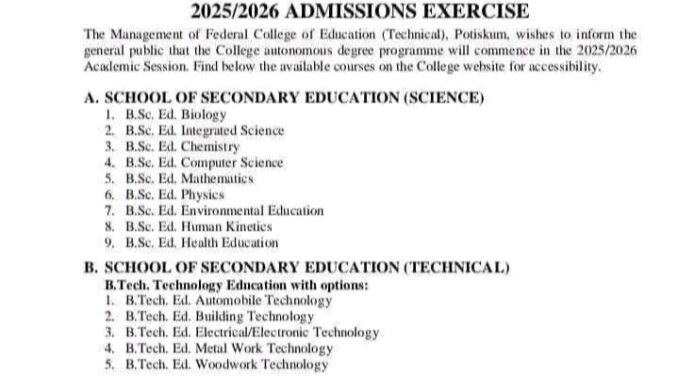
One of the key highlights of the new degree programmes is the wide range of courses offered under the School of Secondary Education (Science). These programmes have been carefully designed to align with modern educational standards and scientific advancement. Students can now pursue degrees in Biology Education, Integrated Science, Chemistry Education, Computer Science Education, Mathematics Education, Physics Education, Environmental Education, Human Kinetics, and Health Education.
Each programme combines in-depth subject knowledge with professional teaching methodology. This ensures that graduates are not only experts in their chosen disciplines but are also fully equipped with the pedagogical skills required to teach effectively in secondary schools, colleges, and other academic settings. The inclusion of Computer Science and Environmental Education reflects the growing demand for digital literacy and environmental awareness in Nigeria’s education system.
Strengthening Technical and Vocational Education
The School of Secondary Education (Technical) further reinforces the institution’s longstanding commitment to technical and vocational training. Newly approved courses include Automobile Technology Education, Building Technology Education, Electrical and Electronic Technology Education, Metal Work Technology Education, and Woodwork Technology Education.
These programmes are particularly important in addressing Nigeria’s need for skilled technical educators and professionals. Graduates will be capable of teaching technical subjects in schools while also contributing practical expertise to industries such as construction, manufacturing, automotive services, and electrical engineering. This approach supports national goals of promoting vocational education and reducing unemployment through skills development.
Business, Vocational, and Entrepreneurial Training
In recognition of the importance of entrepreneurship and economic self-reliance, the School of Business and Vocational Education offers diverse programmes tailored to meet current economic realities. Available courses include Entrepreneurship Education, Office Technology and Management Education, Marketing Education, Accounting Education, Home Economics Education, Agricultural Education, and Theatre and Creative Arts.
These programmes are designed to nurture creativity, innovation, and business competence among students. Graduates will have the knowledge and practical skills needed to become successful educators, entrepreneurs, and professionals capable of contributing meaningfully to Nigeria’s economy. The inclusion of creative arts also highlights the institution’s commitment to cultural development and artistic expression.
Promoting Social Sciences, Arts, and Cultural Studies
The autonomous degree programmes also place strong emphasis on social sciences and arts education. Students can enroll in Economics Education, Social Studies and Civic Education, Islamic Studies, Library and Information Science, and History Education.
These disciplines play a vital role in promoting civic responsibility, cultural awareness, and social development.
Graduates will be equipped to teach, conduct research, and contribute to national development by fostering informed and responsible citizenship. Library and Information Science, in particular, prepares students for careers in information management, research support, and digital knowledge services.
Language, Communication, and Inclusive Education
Language and communication studies remain central to effective teaching and learning. The college now offers Language Arts and Communication, English Education, and Hausa Education.
These programmes are essential for preserving Nigeria’s linguistic heritage while enhancing communication and instructional effectiveness in classrooms.
In addition, the institution has introduced programmes focused on foundational and inclusive education. These include Primary Education, Early Childhood Education, Adult and Continuing Education, Guidance and Counselling, and Special Needs Education. These areas address the educational needs of diverse learners, including children, adults, and individuals with special needs.
Graduates will play a crucial role in ensuring inclusive, equitable, and quality education for all.
Admission Requirements and Application Process
Prospective candidates seeking admission into the autonomous degree programmes can apply through the Unified Tertiary Matriculation Examination (UTME) or Direct Entry. However, applicants must change their first-choice institution to Federal College of Education (Technical), Potiskum via the Joint Admissions and Matriculation Board platform. This requirement is mandatory for eligibility.
HOW TO APPLY
The post-UTME screening process is conducted online through the college’s official portal.
https://screening.fcepotiskum.com.ng
Applicants are required to complete the screening form, upload their academic credentials, and print the acknowledgement slip. A non-refundable screening fee of ₦2,500 must be paid through the REMITA payment platform.
Candidates are advised to provide accurate information during registration, as submitted details will be used for evaluation and official records.
A New Era for Higher Education in Yobe State
The launch of autonomous degree programmes marks the beginning of a new chapter for the Federal College of Education (Technical), Potiskum. The development reflects ongoing national efforts to improve teacher education, expand access to higher learning, and strengthen technical and vocational training.
By offering both NCE and bachelor’s degree programmes independently, the institution positions itself as a growing hub for academic excellence and professional development. It also provides students in Yobe State and across Nigeria with greater access to quality university education without having to travel far from home.
As the college continues to expand its academic offerings and facilities, it is expected to play an even more significant role in producing highly skilled educators, technical experts, and future leaders. For many aspiring undergraduates, the autonomous degree programmes present a valuable opportunity to achieve their academic goals and contribute meaningfully to Nigeria’s educational and economic development.
READ ALSO: Focus College of Education Kaduna PDE Program Admission 2026
Be the first to comment